The key idea
The useful question is which energy reaches which tissue—not which device is universally best.
Why one lifting treatment cannot fit every face
A face may look looser because of changes in skin collagen, fat position or volume, and deeper support structures. A single device name does not describe all of those problems.
The original groups Ultherapy and Shurink as focused ultrasound, Thermage and Oligio as radiofrequency, and Onda as microwave-based treatment. These categories differ in how and where they deliver energy, while their effects can overlap.
Focused ultrasound: small targets at planned depths
Focused ultrasound concentrates energy at selected depths to create small thermal coagulation zones, aiming to induce contraction and remodelling. An early human cadaver study demonstrated focused thermal injury in the SMAS; that anatomical finding is different from proof of a particular patient's visible lift.
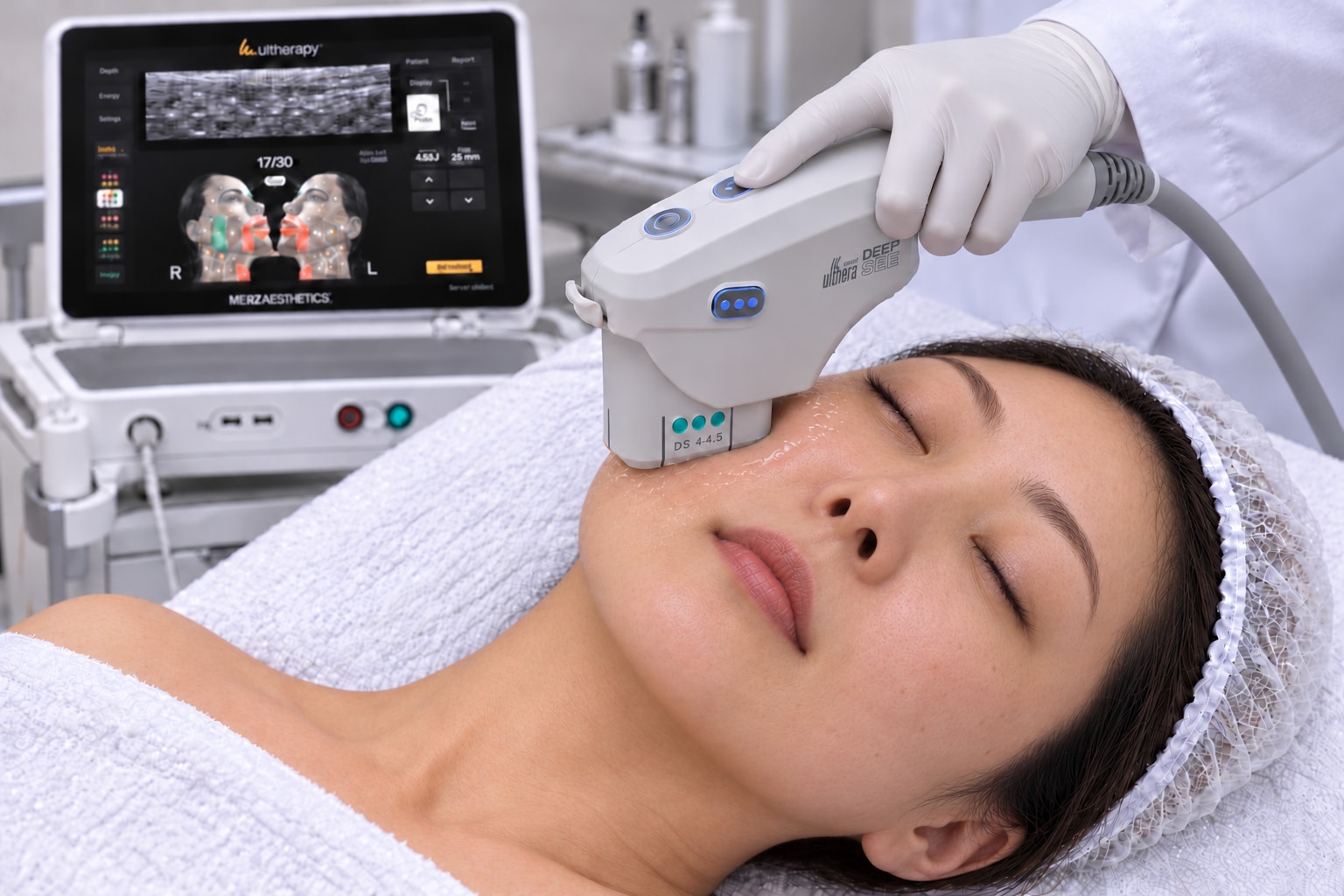
Ultherapy provides ultrasound visualization during treatment. Shurink differs in device design and imaging capability. Transducers, protocols, the area treated, and the individual's anatomy still matter; visualization alone does not establish a universal winner.
Radiofrequency: heating a broader tissue area
Thermage and Oligio use monopolar radiofrequency. Electrical current passing through tissue creates heat through tissue resistance, rather than making the same pattern of small ultrasound focal points.
Clinical literature reports improvements in laxity, elasticity, wrinkles, and appearance with RF. A systematic review found varied studies and outcomes, so its findings should not be read as a guaranteed result for every device or face.
Onda and microwave heating
Onda uses 2.45 GHz microwave energy and dielectric heating. The handpiece and settings influence how heat is delivered to connective tissue and the subcutaneous layer; treatment may address local fat as well as skin laxity.
A small clinical study reported improvements after submental treatment. Those observations support investigation of the approach, rather than proving superiority over ultrasound or RF. The desired effect and amount of existing facial fat need to be considered.
Match the concern to the underlying cause
A descending jawline, fine skin creasing, submental fat, hollow cheeks, and pronounced loose skin are different concerns. Loss of volume may require consideration of a volume approach, while substantial laxity may exceed the limits of a non-surgical device.
Eye-area concerns also require distinguishing loose eyelid skin from brow descent or eyelid ptosis. A device comparison cannot substitute for examining the actual structure and movement involved.
What to discuss before choosing
Ask which tissue is being targeted, how the energy and depth fit your anatomy, and what degree of change is realistic. Skin thickness, fat amount, facial structure, and severity of laxity should guide that discussion.
Simple shorthand such as ultrasound for sagging, RF for elasticity, and microwaves for fat can be a starting point, but the categories are not exclusive. Compare the proposed treatment plan and its limits, rather than only the machine's name.
Your next step
Compare the details of a lifting quote
Ask for the device model, treatment area, shots or other units, and included services. Keep these details together when comparing clinics.
Continue to Keauty onboarding to organize your preferences. A clinician makes the final treatment decision.
Selected references from the original
Edited and translated from Dr. Youro Kang’s Naver blog with permission. This is an adapted article, not a full reproduction. The original publication date is shown above.
리프팅 시술 종류 비교 | 울쎄라, 슈링크, 써마지, 올리지오, 온다 차이점?
Read the Korean original on NaverAbout the author

Dr. Youro Kang · 강유로
Physician · Treatment article author
Dr. Youro Kang (강유로) is a graduate of Inha University College of Medicine and a former clinic director at PPEUM Clinic, Hongdae branch. The treatment articles are adapted for the Keauty journal from the original Korean-language writing.
View full profileThe Keauty Medical Board manages this blog. Authorship and any article-specific medical review are credited separately.