The key idea
Before deciding what to add, compare your current appearance with your original goals and your face before the first treatment.
Why the reference point can move
Perception drift describes a shift in the appearance we use as a reference. A face changed by treatment, or a feature seen repeatedly in images, may start to feel normal; the earlier version can then seem insufficient.
It is an explanatory concept, not a diagnosis. Appearance alone cannot tell us whether someone has had treatment or been overtreated. Lighting, angle, editing, personal taste, and culture also influence judgment.
What visual adaptation research shows
In a 2021 experiment, 48 women viewed digitally altered faces with thinner or fuller lips. Subsequent judgments of attractiveness shifted toward the lip fullness they had been shown. This supports the possibility of visual adaptation, rather than a universal ideal lip size.
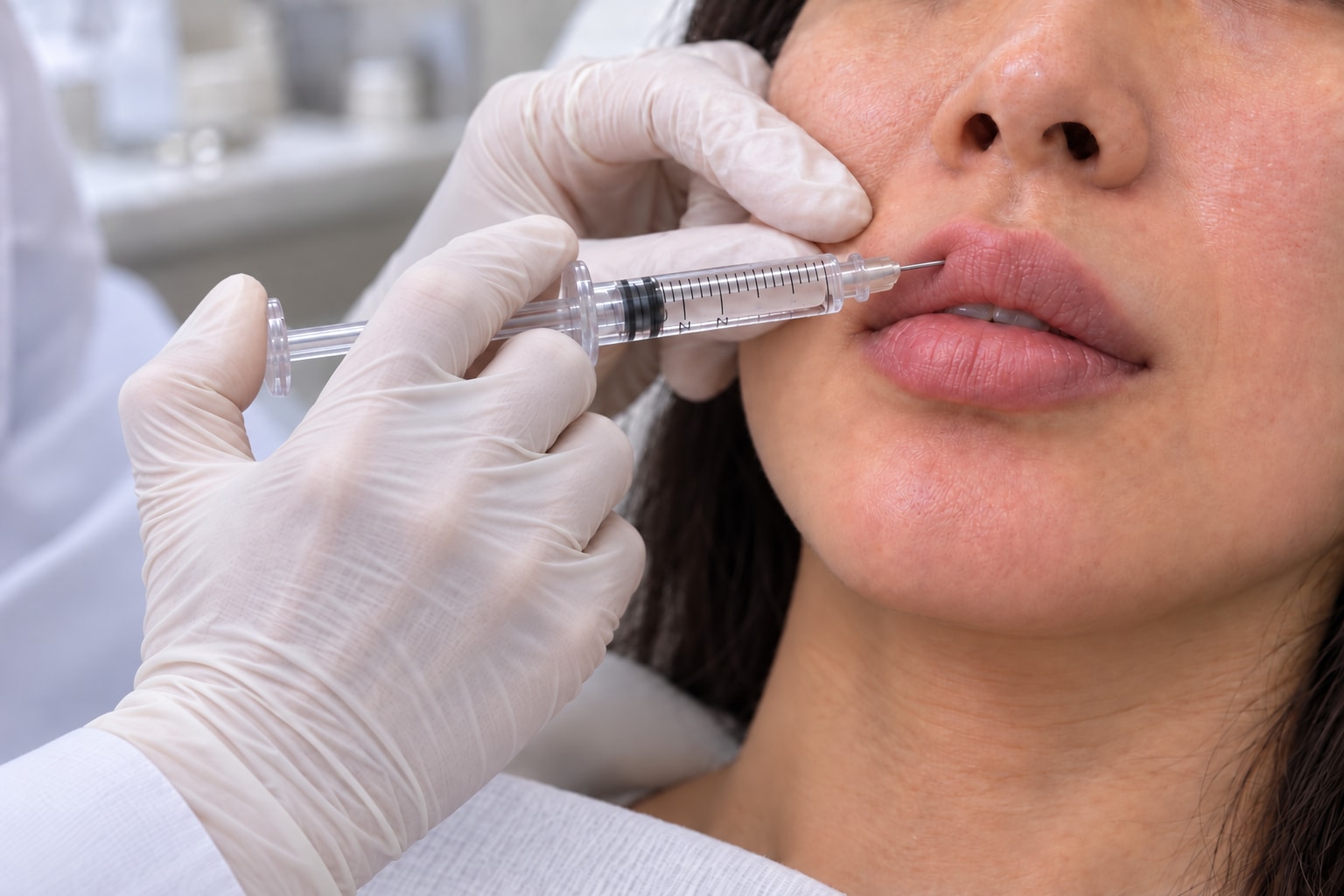
Qualitative interviews with women who had prominent changes after lip filler also describe changing reference points. These findings do not mean that every wish for further treatment is caused by drift. The thumbnail illustrates a consultation about lip proportions; it does not document a patient's treatment.
Time passing does not prove filler is gone
A 2024 MRI review found residual hyaluronic acid filler in 33 people who reported no further mid-face filler for at least two years. It was not a study following 33 people for fifteen years, and it cannot tell us how long all lip fillers last.
The important question is whether a change reflects fading swelling, actual volume change, or simply becoming used to the result. A calendar interval alone is insufficient justification for adding more.
Look at the whole face and its movement
A fuller lip or sharper chin may look appealing in isolation while changing the balance of the whole face. Review the front, profile, and a natural smile, along with original anatomy, injection placement, and cumulative treatment.
Compare the first pre-treatment photographs with your present appearance, ideally using similar lighting, distance, and angle without filters. Age and weight changes also belong in that comparison.
The clinician's reference point matters too
A doctor regularly exposed to particular results may also become accustomed to them. Professional aesthetic drift has been proposed as a framework for examining that possibility; it is not a prevention method already proven by clinical trials.
A consultation should include an independent judgment about whether adding treatment would help. Discuss the option of stopping or waiting alongside further change, rather than treating a request for more as sufficient on its own.
Four ways to revisit your goal
Return to your appearance before the first treatment. Describe the overall impression you wanted and the features you want to keep. Take a break from repeatedly viewing a narrow range of celebrity or treatment images, and look at a broader range of faces.
Ask the clinician how their judgment fits your own preferences. If the result now feels unfamiliar or excessive, review the product, timing, recovery, and current anatomy before adding another procedure. More visible change and greater satisfaction are different outcomes.
Your next step
Take time with your filler decision
Ask who will assess your goals, which product and area are proposed, and what follow-up is available. You can use the consultation to decide whether to proceed.
Continue to Keauty onboarding to organize your preferences. A clinician makes the final treatment decision.
Selected references from the original
Edited and translated from Dr. Youro Kang’s Naver blog with permission. This is an adapted article, not a full reproduction. The original publication date is shown above.
입술 필러, 왜 점점 과해질까? 미의 기준이 달라지는 ‘원점 표류’
Read the Korean original on NaverAbout the author

Dr. Youro Kang · 강유로
Physician · Treatment article author
Dr. Youro Kang (강유로) is a graduate of Inha University College of Medicine and a former clinic director at PPEUM Clinic, Hongdae branch. The treatment articles are adapted for the Keauty journal from the original Korean-language writing.
View full profileThe Keauty Medical Board manages this blog. Authorship and any article-specific medical review are credited separately.