The key idea
A laser setting only makes sense alongside its wavelength, pulse duration, target, and delivery mode. One number cannot tell you how strong or suitable a treatment is.
Five parameters describe different things
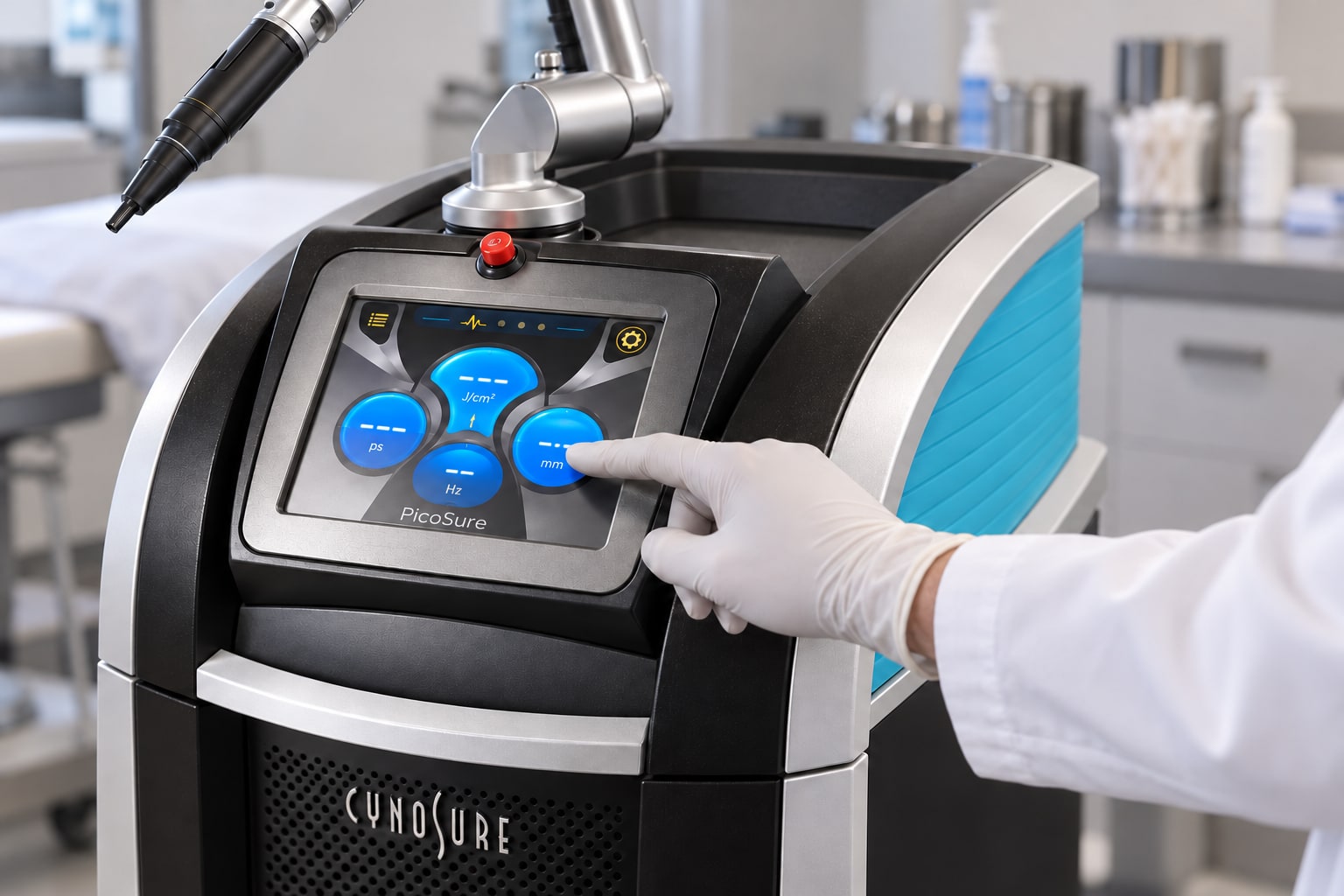
Wavelength, measured in nanometres (nm), describes the light. Fluence, in J/cm², describes energy per area. Pulse duration describes delivery time. Spot size, in millimetres, is the beam diameter. Frequency, in hertz (Hz), is the number of pulses per second.
Together they shape tissue interaction. Understanding these terms helps you ask about a treatment, but the values shown on a particular device are not a standard plan for every patient.
Wavelength: absorption and scattering
Light entering skin can be reflected, transmitted, scattered, or absorbed. Melanin, haemoglobin, and water are important chromophores: substances that absorb light differently at different wavelengths.
Compared with 1064 nm, 532 nm is more strongly absorbed by melanin and often used for superficial pigment. Normal epidermal pigment can also absorb energy, making skin type and unwanted pigment changes relevant.
Longer does not always mean deeper
Within this comparison, 1064 nm generally penetrates more deeply because of its absorption and scattering properties. It does not follow that every longer wavelength travels deeper.
Er:YAG at 2940 nm and CO₂ at 10,600 nm are strongly absorbed by water, so they can act superficially despite their longer wavelengths. Depth is determined by tissue optics as well as wavelength.
Fluence and pulse duration belong together
Fluence is energy divided by area. With other conditions held constant, increasing it increases energy delivered per unit area, but the number alone cannot fairly compare different lasers.
The same energy per area delivered over a shorter pulse can produce a higher peak irradiance and a different tissue response. Pulse duration is why lasers sharing a wavelength may be used for quite different purposes.
Spot size changes more than the treatment footprint
A larger beam often allows useful light to travel more deeply under comparable conditions, because a smaller proportion of scattered light escapes through the edges of the treatment area.
That is a tendency shaped by the tissue and device, rather than a rule that the largest spot is always best. Spot size has to be interpreted together with the other parameters and the intended target.
Hz is repetition rate, not the strength of one pulse
Ten hertz means ten pulses per second. It does not mean each pulse is stronger than a pulse delivered at one hertz. Repetition rate can affect treatment speed, accumulated energy, and heat buildup.
Ask what each chosen parameter is intended to achieve in your skin. A screen's settings or a guide's example should not be copied as a self-treatment or universal treatment protocol.
Your next step
Plan a pigmentation consultation around your trip
Bring your visit dates and questions about diagnosis, proposed treatment and follow-up. Ask the clinician what fits your circumstances.
Continue to Keauty onboarding to organize your preferences. A clinician makes the final treatment decision.
Selected references from the original
Edited and translated from Dr. Youro Kang’s Naver blog with permission. This is an adapted article, not a full reproduction. The original publication date is shown above.
색소 레이저 기초 | 파라미터 뜻과 읽는 법: 532nm, 1064nm, Fluence, Pulse duration, Spot size, Hz
Read the Korean original on NaverAbout the author

Dr. Youro Kang · 강유로
Physician · Treatment article author
Dr. Youro Kang (강유로) is a graduate of Inha University College of Medicine and a former clinic director at PPEUM Clinic, Hongdae branch. The treatment articles are adapted for the Keauty journal from the original Korean-language writing.
View full profileThe Keauty Medical Board manages this blog. Authorship and any article-specific medical review are credited separately.