The key idea
The question is not simply how much muscle to reduce. It is whether reduction suits your face, while preserving your smile, chewing function, and facial volume.
The muscle behind jaw slimming
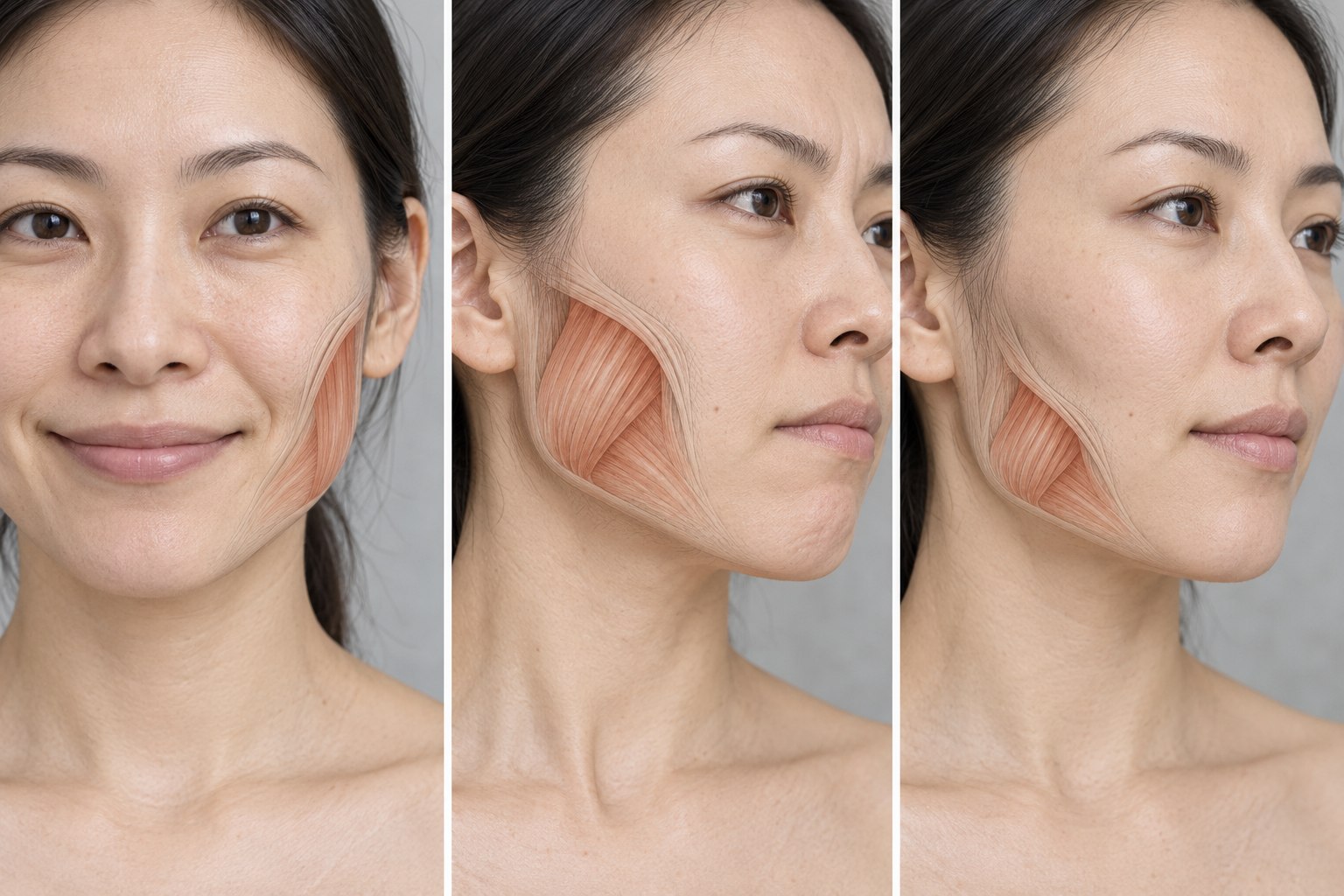
Masseter treatment targets a chewing muscle that becomes firm beside the jaw when you clench your teeth. Close to its front edge is the risorius, which helps pull the corners of the mouth sideways when you smile. A treatment intended for one muscle can affect the neighbouring muscle.
Jaw width is not always caused by a large masseter. Bone shape, existing cheek volume, prominent cheekbones, and skin laxity all matter when deciding whether and how much muscle reduction is suitable.
Why can smiling feel uneven?
If toxin affects the risorius, the mouth corner may move differently and the smile can become asymmetric. The original describes checking the masseter’s front border during clenching and planning injection position, depth, and dose within the target muscle.
Supporting the border with a finger is not a barrier that completely stops diffusion. If your smile changes, contact the treating clinician and compare movement before and after treatment. Recovery generally depends on the effect wearing off. Additional treatment should follow an assessment of the cause, rather than a promise of an immediate reversal.
What causes the bulge when you clench?
Paradoxical masseteric bulging means part of the muscle protrudes after treatment when you clench. The masseter has different layers, fibre directions, and internal tendons. If some compartments weaken while others keep contracting, the remaining contraction can appear as a bulge.
The deep inferior tendon may contribute to uneven distribution. A small ultrasound case series also found a pattern in which a deeper contracting compartment pushed the outer muscle outward. There is more than one possible mechanism; a bulge does not simply prove that the total dose was too low.
The original describes distributing treatment across appropriate depths within the masseter while avoiding nearby expression muscles. A clinician may consider targeted additional toxin in a still-active area after assessment. It is not a reason to add a large dose to the entire muscle.
Why can cheeks look more hollow?
Botulinum toxin does not directly dissolve cheek fat. Reducing masseter volume changes the facial contour, especially if the upper muscle loses substantial volume. Hollowing beneath the cheekbone can become more noticeable in a face that already has little volume or prominent cheekbones.
The original recommends considering existing hollows, laxity, injection height, and total dose, and being conservative in low-volume faces. If hollowing appears, assess the course as the toxin effect fades before rushing to fill it. Tell the clinician about previous hollowing before the next treatment so the dose, area, and interval can be reconsidered.
Bruxism and aesthetic treatment have different goals
For grinding or clenching, the relevant outcomes include jaw pain, fatigue, and contraction strength. In one randomized sleep-bruxism trial, contraction intensity decreased for up to 12 weeks, but the frequency of grinding episodes did not significantly fall. Weakening a contraction does not remove every cause of bruxism.
For jaw contouring, reassess how much the muscle has regrown and whether facial volume has become insufficient. Study schedules vary; purpose alone cannot determine dose or retreatment timing. Product units are not directly interchangeable, and there is no single dose that guarantees freedom from side effects.
What should you discuss at follow-up?
Repeated treatment of an already reduced muscle may produce more reduction than intended. A small study found lower muscle thickness and activity after repeat treatment at three months, but it did not compare rates of cheek hollowing. This does not prove that every three-month schedule causes hollows, or that waiting six months prevents them.
Dr. Kang advises reducing prolonged chewing of tough foods and repeated gum chewing for roughly two weeks after treatment. Other chewing muscles, including the temporalis, can take on more load; changes have been reported in a small trial. Follow the instructions of the clinician who assessed you.
Bring up both your goals and your concerns: an earlier uneven smile, hollowing, chewing discomfort, or a wish to keep a natural expression. These details help guide a more careful plan than a fixed dose or a date on the calendar.
Your next step
Prepare your botulinum toxin consultation
Bring questions about the brand, units, intended areas and expression goals. Ask the clinician to explain the proposed plan before comparing quotes.
Continue to Keauty onboarding to organize your preferences. A clinician makes the final treatment decision.
Selected references from the original
Edited and translated from Dr. Youro Kang’s Naver blog with permission. This is an adapted article, not a full reproduction. The original publication date is shown above.
사각턱 보톡스 부작용: 사탕볼, 볼패임, 입꼬리 비대칭! 웃는 게 어색한 이유?
Read the Korean original on NaverAbout the author

Dr. Youro Kang · 강유로
Physician · Treatment article author
Dr. Youro Kang (강유로) is a graduate of Inha University College of Medicine and a former clinic director at PPEUM Clinic, Hongdae branch. The treatment articles are adapted for the Keauty journal from the original Korean-language writing.
View full profileThe Keauty Medical Board manages this blog. Authorship and any article-specific medical review are credited separately.